The essence of faith
We live in a time where everything is changing rapidly, technologies and services are reaching a new level, science and AI can provide answers to most questions, life requires the ability to learn quickly and adapt to its challenges… All that will only progress.
If the topic of faith isn't close to you, if you hesitate about whether faith makes sense at all, or whether there is even a need to imrove your faith, this article is for you.
Those who consider faith archaic or push it into the background are becoming more and more numerous, even at a time when the world is engulfed in wars and stability is disappearing. And the reasons are quite simple:
- people have become more trusting in science, scientific discoveries, because much of what was once a gap in knowledge has now been studied by science;
- social arrangements have become much better than they were in the Middle Ages or even 50 years ago;
- the realities of life are prompting an increasing percentage of people to lean only to a critical approach, to question any authorities and statements, unfortunately even when they are based on morality.
But does this mean that the need to believe disappears? Let's walk along the path of reflection, understand the arguments "for" and "against". I will give examples of a real-life nature and try to show through philosophical analysis why such a concept as faith still exists and what it means.
Philosophical analysis
Replacing faith with reason or science is just as impossible as replacing mathematics with history or music with sculpture.
During my student years, I worked on translating a philosophical article that I published in Research. I will briefly describe only a few important theses.
The article begins by saying that faith, if it has a place and a meaning, is a concept that is not commensurate with others, such as experience or reason. Therefore, there is no need to look for ways to combat it, or an alternative, as if something like reason could displace or completely replace faith.

If this seems too abstract to you, I would like to give a simple example. Imagine a person lying on the operating table. The success or failure of an operation depends not on one, but on several components that cannot separately lead to the desired result. For the operation to be successful, it is important that the doctors are experienced professionals. Along with the knowledge and competence of the doctors, any experience finds its place where the situation and case may be different. After all, various external factors (such as weather, safety and conditions for recovery after surgery) and internal factors (for example, the preferences of the person who will be operated on, weight, body characteristics) affect. We know that historically, with experience, an anesthesiologist is involved in the operating staff, who helps the person to endure the operation as easily as possible. If there was experience, but at the same time the doctors did not have sufficient knowledge, understanding, the chance of success is significantly reduced. But with only knowledge and competence in the absence of experience, the chance of success can decrease by the same amount. Despite this, the third condition is also important - faith. Let's try to imagine doctors who would not have faith in what they are doing during the operation. No matter how professional they are, without faith they would have neither the courage, nor the assurance, nor even the motivation to continue this great work in life. Also, without the faith of the person who is to be operated on, he or she would hardly agree to the operation or trust the doctors. Nowadays, everything seems easier. But imagine how doctors intervened in the past, when anesthesia was not yet discovered: how the faith of both parties influenced the course of the process.
Of course, without experience, the mind is raw in itself. Just like molecules and atoms that do not find their purpose. This is what happens when we try to understand something with the mind alone:
We only abstract the data with the help of sense facts from their particular and accidental features, reduce them to known and general concepts.
We decompose the data of experience, separate or reject the accidental and transient elements. In result we recieve a known general idea or concept that has no content of its own in itself, and in the implementation of which, therefore, the mind does not introduce anything new.
(from the treatise I referred to in Research)
The rather old concept of empiricism that is a property of knowledge or research, based on experience. It finds its place in various sciences, starting with such as philosophy. In this way, empiricism helps to distinguish from random things and signs that which is scientific, regular.
I hope you grab some points for yourself. 😊 Then the questions would be following:
How can faith play a useful role and at the same time not contradict sober thinking and science? Can faith play a useful function in any situation, not just in isolated and critical cases?
You will probably find some answers to the first question later on, reading the article.
In my experience, I have never seen a sober faith (the one that should be, not a distorted faith) bring harm. Yes, there were times when I did not receive what I believed in. Instead, I gained experience and wisdom, and I began to treat some things differently. But this did not harm me or people. Therefore, it was not a negative experience.
Answering the second question, I can confidently say that a healthy faith serves a person not only in isolated cases. It allows a person to move through life towards something, to strive for something better, to change himself (herself) and change the world, to overcome difficulties and be a winner in times of crisis, to be a person of influence and not of dependence... – this list can be continued. 😌
When we believe in the triumph of good over evil, in love and its meaningfulness in life, in the Creator and His supreme law, which is perfect, in the absoluteness of morality, which brings harmony to life when its uniformity for all people becomes universally recognized, we do not cut off part of our dignity, and we do not belittle the role of mindset. Also, experience should not testify to the opposite: "I believe, but you know, life sometimes forces you to be a scoundrel" – which is usually called "double standards" and leads to the destruction of both one's own life and public goods. Therefore, faith is logically necessary.
Якщо розум відповідає на питання "що є, буває і може бути?", віра відповідає на питання іншого гатунку: "що є безумовно і повинно бути?"
In my opinion, faith does not contradict science and mindset or wit. On the contrary: it can (and even in certain cases should) coexist with mindset, as a unique category of a single organism. Not the superstitious belief in something mystical that worsens a person's life, but the one that really brings benefits.
How do healthy faith and reason interact?
Faith affirms the existence and action of known things that lie beyond our ordinary knowledge. If faith thus communicates to our consciousness known positive data, concretely determined, then the task of reason in relation to faith can only be to free or purify the data communicated by faith from the element of chance and arbitrariness and to impart to them the form of generality and necessity.
In the following examples, I will show how faith can make us not dependent or weak, but strong and wise people.
Real-life examples
Earlier, I listed 3 main criteria of atheists, agnostics, and skeptics that make the need for faith obsolete. Although, whether you agree or not, I constantly notice that both believers (people who are not blind believers) and non-believers extol such concepts as mindset (rationo, which from Latin means "reason", "thinking", "knowledge") and critical thinking (analysis, common sense, the need to ask the question "why?"). What is interesting? For both, morality, ethics, and various human virtues are values in most cases. I don't know what percentage of people these are values for, but even after two millennia, it is huge. So far, neither science, nor critical thinking, nor the level of social systems have forced us to restructure the foundation of society, which is based on the same morality and responsibility.
Science occupies its niche in almost all matters, although behind numerous studies lies an incomparably greater trail of unexplored things. But here is an interesting question about the same rationality: Is it reasonable to be inclined to think that someday scientists will be able to explore everything that is still unknown, when we do not have the slightest guarantee of this?
When evolutionists talk about social norms, systems, and norms, their argument is that society has abandoned dogmas and postulates, which is why many problems were overcome in the past millennium. There is a lot of truth in this. But it makes a lot of sense to look for derivative reasons, for example, why those dogmas and postulates that were used by the authorities and the religious elite hindered this healthy process. Where did they have a useful or negative function? More important questions: Have they all been abolished? Actually, what is rotten or superstitious, and what is the foundation? And what exactly led society to the ways of coexistence that we have now, to which past generations once aspired?
It will also be quite interesting to reflect on such a thing as critical thinking, which is often perceived by us as the opposite of faith. With the help of critical thinking, we check the facts, give room for doubt and look for evidence of this or that. Regarding this point, I would like to focus more in the following sub-points.
Faith as a useful element
Perhaps it is best to explore the essence of faith for yourself through experience to see what its significance is.
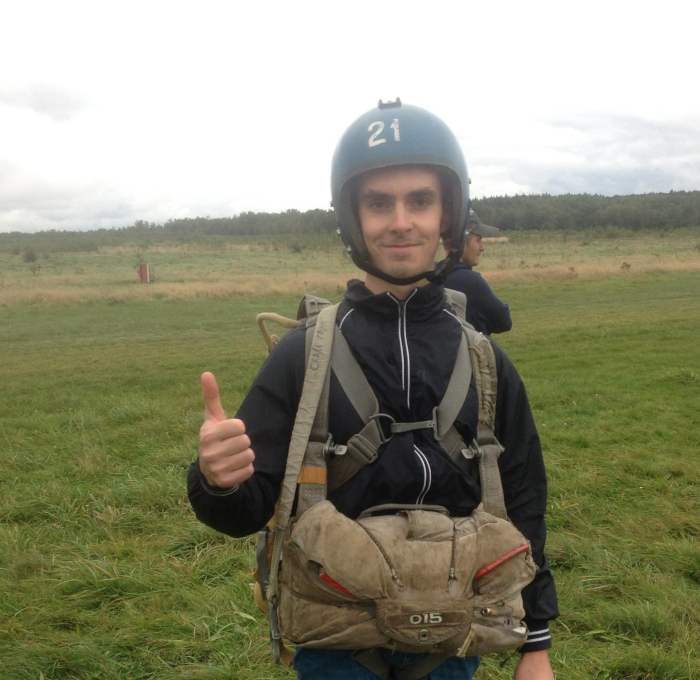
One of the vivid examples of where faith played a useful role was when, back in 2017, colleagues from my first job planned to go to the airfield to do a parachute jump. For me, it was the first time in my life, I hesitated for a week before, but still decided to go with them. Before taking off on a cornfield, we prepared for the flight and landing, listening to the instructors. In such moments, your faith can play a decisive role, even before you get on the plane. After all, once you get on the plane, there is no turning back: either you jump or you are pushed out. 😄 One way or another you will end up overboard 800 m above the ground, unless you feel sick and you warn the staff in advance. For me it was the most extreme thing I have ever tried in sports and leisure. When I was flying, until the moment the parachute opened, I closed my eyes and counted the seconds, believing that the parachute would open.
I will note that faith works from different sides here: trust in the instructor, in his competence and experience, both at the training stage and in the flight, faith in yourself, and faith in the Almighty, which someone may not have, but I prayed that everything would go well. In such stories, there are always risks: weather conditions, which were not the best in the fall, your moral and physical condition, which is extremely important here, as well as landing, which is important to do correctly.
If you analyze that, it was not just a matter of believing in a successful flight or not, leaving or giving up. In the subconscious of a person there is faith in both the first and second cases. The faith that I talked about, and the belief in a negative development of events. It sounds easy, but there is a lot of sense in thinking about it!
Belief in different scenarios of events, faith in man, in God, in victory over the enemy – all this takes place when we do not have a knowledge base, guarantees about the future, and perhaps do not yet have personal experience to be convinced of something. This is where faith plays a significant role. And, as you probably already noticed, there are always people on both sides. Some will believe one thing, and others the opposite. In the next article on this topic, I will talk about faith that is supported by personal experience.
The next example I would give is also from real life. When the full-scale war began, in the first year my friends from church and I were involved in volunteer work, helping various military personnel serving in hot spots. One of these military personnel with whom I kept in touch was Roman, a man who had two children. Unfortunately, after a short leave, his life was cut short when, as a commander, he evacuated wounded comrades at the site of the shelling. He was returning to the newly wounded and at that moment there was an enemy hit that became fatal for him. A week before that, Roman and I were still in touch. I felt his faith, and the sincere gratitude that many people lack now. Roman's last words were "With God's help, we will come to victory."
In my opinion, it was faith that played a key role in the path Roman took. Yes, he did not return home alive, but he went through a long and difficult path that hardly anyone else would have gone through without faith in the truth of values, in justice, and in God's power to help Ukrainians achieve this justice. His role in this was modest. But it is worth thinking: what if at the last minute, instead of acting and saving his brothers, he hesitated?
What about the spiritual? What if we doubt the existence of God, His final judgment, and life after death? I think this is a good question for agnostics. After all, an agnostic would say: "I can't say that God exists, but I also can't say that He doesn't exist." Agnostics take a seemingly convenient position: to remain in doubt. However, the interesting question is: "What good would such a position be if we understand that life is a rather unstable thing?"
A skeptic or agnostic can postpone important questions for later, and there is no guarantee that he will return to them. There is a better option. He (she) can be in constant research, read philosophical books, weigh all the pros and cons of one position and another. All this can last for years. After all, in this way we may never be ready for a final answer, since it may happen in life that a choice must be made here and now. We can remain in our doubts and without an answer, guided only by rationality and experience (or lack of this experience). An atheist can remain with the idea that there is no God, that morality is relative, and victory over evil and injustice or its absence is like a game of roulette.
Many of these people do not have faith not because they cannot believe, when they assume that certain things are true, but because they simply do not want to, for some reason. One of the modern religions is when a person does not believe in God as He is described in the Bible, but at the same time believes that our life is a matrix, that we are in it, and the real players are outside it. But you must agree, such a faith combines many times more illogicality and irrationality than when trusting biblical truths. This is worse than even remaining in doubt, when there is room for further search.

Let's take a closer look at a famous philosophical argument called "Pascal's Wager." It was proposed by the French mathematician and scientist Blaise Pascal in his work «Pensées (Thoughts)» in 1657-1658.
His argument is here:
Pascal suggests looking at faith as a game where a person makes a bet: to believe in God or not.
Option 1 – God exists. If you believe, you get eternal happiness (infinite gain and success). If you don’t believe – a terrible eternity without God.
Option 2 – God doesn’t exist. If you believe and after death it turns out that God is absent, you have lost some time and earthly pleasures, while you have become a better person in life. If you don’t believe – you gain nothing, but your time and effort will be a minimal loss.
Another example is composed, but it can often be true, even in our time. Try to imagine yourself in the place of a person whose apartment is on fire in a multi-storey building on the 8th floor. Imagine yourself in the place of this person who is thinking about what to do while standing on the balcony of the burning apartment. The rescuers have arrived and placed a rescue trampoline right under the person's balcony. The resident of the apartment can rationally consider the chance of whether he will survive if he jumps. The rescuers also do not look very confident, and time is limited. What choice would you make in this person's place? If you stay in the apartment, there will be no chance of survival. But if you jump, then you have some chance of survival!
A category like faith is not characterized by the mindset of "I will do it because I have guarantees." As in the case of surgery and the operating room (the example I gave above), so in the case of fire rescue, believing can mean "I don't know, I'm not sure, but I will try." This is the nature of faith. You don't know what will happen, but you make a choice. And in the end, you will not be left in the loser. Even if not, depending on the situation and the example, but in life you will be a person of faith, then you become more successful, because you grab not for doubts and skepticism, but for possibilities.
This is where faith comes into play. And this is where, as I described in the philosophical analysis, faith and reason come into play. We can use our mindset without faith and calculate probabilities, but ultimately a choice must be made. Faith allows us to be more decisive. It is more reasonable than standing on a balcony and calculating probabilities (ratio-). In addition, it can simply help you save yourself or another person. Of course, no one would want such trials, although life can also pose similar challenges. Regarding the spiritual plane, everything happens in a similar way. God extends His hand to man, offers him His way to Heaven and life with Him. And this chance to make a choice is, although not as stressful, but equally relevant for everyone.
But the nature of faith is not only to help us stay morally and psychologically strong! As I wrote, it is not necessarily a matter of lack of faith, but of what our faith is based on, whether it is based on strong convictions or rather unfounded (situational) and based on some isolated experience. Very important:
- in what exactly do you believe;
- how do you believe.
Faith, like mindset, is tested by life circumstances to see how strong it is. At the same time, these same circumstances and challenges can help you test it, what it is based on, returning to the question "What do I believe?". Try to reflect on this and compare the answer you get with the answer to the question "What are my beliefs based on?".
In an article I will publish later, you will be able to look further into how faith becomes effective.

Comments
No Comments